Traveller’s diarrhoea treatment in Bang Tao
You are on the fifth trip to the bathroom, you have a boat booked for tomorrow morning, and you are trying to decide between the tablets from the pharmacy and simply riding it out. It affects a large proportion of visitors to Southeast Asia. Traveller’s diarrhoea treatment in Bang Tao comes down to replacing fluid properly and knowing which medication helps and which quietly makes things worse.
What actually causes it here
Most cases are bacterial, with E. coli the commonest, picked up from food or water carrying organisms your gut has simply never encountered. Viruses such as norovirus cause the outbreaks that sweep through hotels and dive boats. Parasites like giardia are less common and cause a longer, more drawn-out illness with bloating and foul-smelling stools.
The usual routes are ice from an unreliable source, salads rinsed in tap water, fruit peeled hours earlier by someone else, and food held warm rather than hot. It is worth repeating that street food is not inherently riskier — turnover and cooking temperature matter far more than the setting.
Rehydration is the treatment
Everything else is secondary, and getting this right prevents most of the complications.
Oral rehydration salts beat water, soft drinks and sports drinks comfortably. The specific ratio of glucose to sodium in ORS is what allows the gut to absorb water actively rather than let it pass straight through, which is why it works when plain water does not.
Sachets are cheap in every Thai pharmacy. Mix with bottled water and sip steadily through the day, aiming to keep your urine pale. Cola and sports drinks are too sugary and can worsen the diarrhoea by drawing water into the bowel — the opposite of what you need.
When loperamide helps and when it harms
Loperamide slows the gut. That is useful in some circumstances and actively dangerous in others.
It is reasonable for watery diarrhoea with no fever and no blood, particularly if you have a flight, a long journey, or a boat trip where a bathroom is not available. It buys you function, not recovery.
Do not take it if you have a fever, blood or mucus in the stool, or severe abdominal pain. In those cases the diarrhoea is your body expelling something that needs to leave, and holding it in risks serious complications. Never give it to a young child.
When antibiotics are appropriate
Most cases settle in two to four days without them, and taking antibiotics for every loose stool drives resistance — a genuine and growing problem in this region — and can prolong how long you carry some bacteria.
They are worth using for moderate to severe illness with fever, for blood in the stool, or when symptoms are not improving after three days. The doctor decides after examining you, and where useful a stool test identifies the organism so the right antibiotic is chosen rather than a broad guess.
Persistent diarrhoea lasting beyond two weeks points towards giardia or another parasite, which needs a completely different medication and will not respond to standard antibiotics.
When it is more than a stomach bug
Come in the same day if there is:
- Blood or mucus in the stool
- Fever above 38.5C
- Six or more watery stools in a day
- Dizziness on standing, or barely passing urine
- Severe pain concentrated in one area
- Any diarrhoea in a young child that is not settling
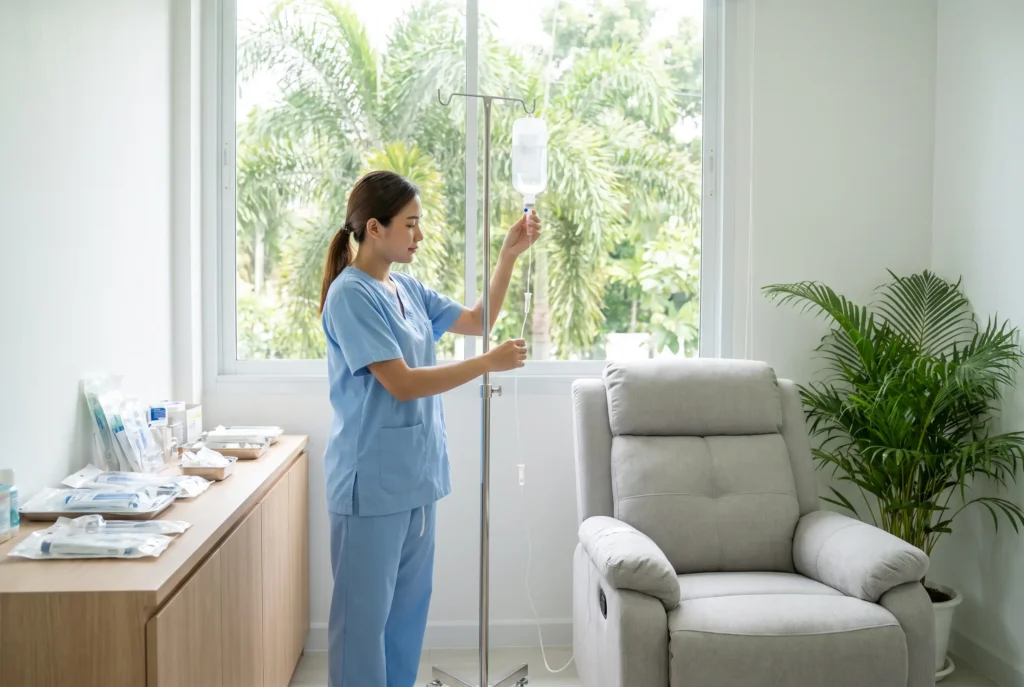
Dehydration is the real danger and in this heat it arrives faster than people expect. If you cannot keep fluids down, an IV drip corrects it within about an hour. See also food poisoning.
Getting back to normal afterwards
The gut takes longer to recover than the symptoms suggest. Loose stools for a few days after the infection has cleared are normal and do not mean it has returned.
Temporary lactose intolerance is common after a gut infection — the enzyme that digests milk sugar is produced by cells at the tips of the gut lining, which are exactly the cells damaged. Avoiding milk for a week or two often clears up lingering bloating and looseness that people otherwise assume is a second infection.
Reintroduce food gradually, favour plain starchy items first, and go easy on alcohol and very rich food for a few days. If symptoms return after a clear period, or if bloating and foul-smelling stools persist beyond two weeks, come back — that pattern suggests a parasite rather than a relapse, and it needs a different treatment entirely.
Frequently asked questions
How much does treatment cost?
A consultation with rehydration advice and anti-nausea medication is inexpensive. Stool testing and IV fluids cost more and are quoted before being started.
Should I stop eating?
No. Eat plain food when you feel able — rice, toast, bananas, clear soup. Starving yourself slows recovery of the gut lining rather than resting it.
Can I still go on my boat trip?
If you are dehydrated or feverish, no. A day offshore with no shade and no bathroom turns a manageable illness into a serious one.
Can a doctor come to me?
Yes. A doctor hotel visit covers Bang Tao, Cherng Talay, Laguna and Layan at any hour.
How do I avoid it for the rest of the trip?
Bottled or filtered water including for teeth, food that is hot and freshly cooked, peel your own fruit, and wash your hands before eating. Hand hygiene prevents more cases than avoiding street food does.
Why do I still feel bloated a week later?
Usually temporary lactose intolerance after gut infection. Cut out milk for a week or two and see whether it settles. If it does not, come back — that pattern can indicate a parasite.
Come in, or we come to you
Take Care Medical Clinic Bang Tao is open open 24 hours, 7 days a week on Bandon Road in Cherng Talay, a few minutes from Bang Tao Beach and Laguna Phuket. Walk in without an appointment, call +66 81 718 9080, or message us on WhatsApp. If you would rather not move, ask for a doctor hotel visit and we will come to your room.