Skin rash treatment in Bang Tao
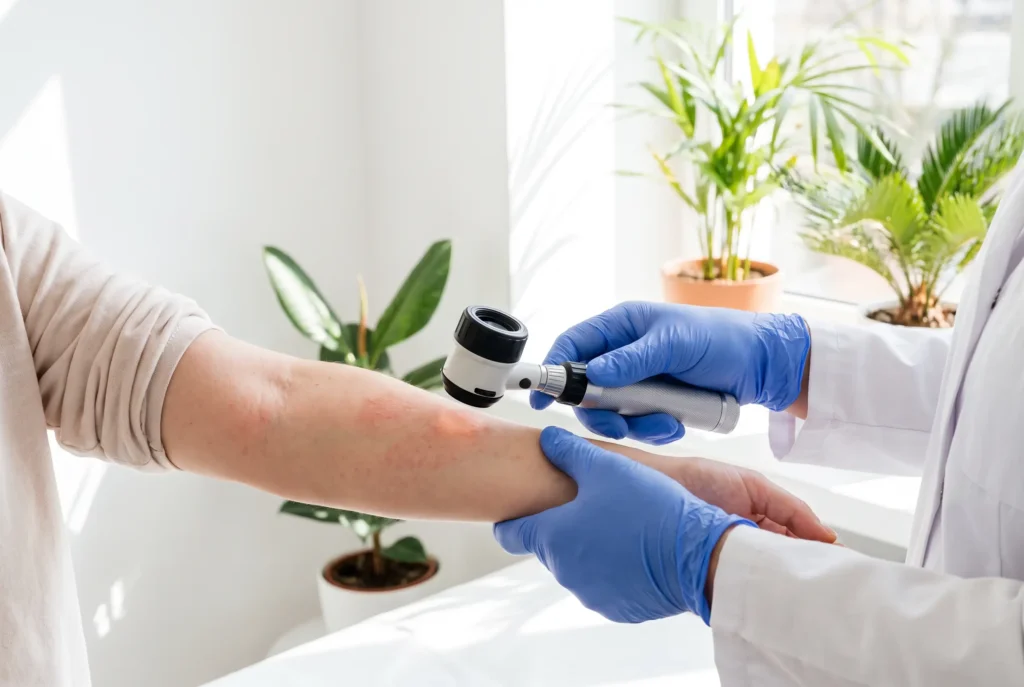
A rash that appeared overnight is unsettling, particularly after a week of swimming in the sea, walking through vegetation and sweating continuously. Most holiday rashes here turn out to be heat, fungus or an allergic reaction, and they respond quickly once correctly identified. Skin rash treatment in Bang Tao is mostly about naming the rash accurately, because the creams for each are different and using the wrong one can make things noticeably worse.
The rashes we see most
A short list covers the large majority:
- Heat rash — tiny itchy bumps where clothing traps sweat
- Fungal rash — pink or pale patches in skin folds, groin and under the breasts
- Contact reaction — a rash exactly where something touched the skin
- Hives — raised itchy welts that move around and change shape within hours
- Sea bather’s eruption — itchy bumps under the swimsuit after sea swimming
- Infected bites — see insect bite treatment
Heat rash and fungal rash get confused constantly
They are treated in opposite directions, so getting it wrong prolongs things considerably.
Heat rash comes from blocked sweat glands and is best treated by cooling and drying — light loose clothing, cool showers, air conditioning and calamine. A steroid cream helps briefly.
Fungal rash thrives in exactly the same warm damp conditions but needs an antifungal cream, and putting a steroid cream on it makes it spread and blur at the edges. Fungal patches tend to have a defined, slightly raised border and sit in skin folds. If a rash has been treated with hydrocortisone and got worse rather than better, it is fungal until proven otherwise.
Rashes that come from the sea
Sea bather’s eruption produces intensely itchy bumps under the areas covered by a swimsuit, caused by tiny jellyfish larvae trapped against the skin by fabric.
The critical detail is that rinsing in fresh water while still wearing the swimsuit makes it dramatically worse — the change in salinity fires the remaining stinging cells all at once. Take the swimsuit off first, then shower, and wash the swimsuit in hot water before wearing it again.
Stings from contact with actual tentacles are a different problem entirely and are treated differently — see jellyfish sting treatment.
When a rash needs urgent attention
Go to a hospital or call 1669 immediately if the rash comes with:
- Swelling of the lips, tongue or throat
- Difficulty breathing or a tight chest
- Feeling faint or collapsing
- A rash that does not fade when pressed with a glass
- Fever with a spreading rash and feeling very unwell
- Skin peeling in sheets, or blistering around the mouth and eyes
A rash with breathing difficulty is anaphylaxis until proven otherwise. A non-blanching rash with fever needs immediate assessment for meningococcal infection. Neither is something to photograph and think about.
What helps while it settles
Keep the skin cool and dry, wear loose cotton rather than synthetics, and shower off salt and chlorine promptly rather than letting them dry on you.
Antihistamine tablets reduce itching and are most useful taken at night, when itching reliably peaks. Avoid scratching — broken skin here becomes infected quickly and turns into cellulitis faster than it would at home.
Keep sun off an inflamed rash. Some medications and plants cause reactions triggered by sunlight, and a sunburnt rash is far harder to settle than either problem alone.
Photographing it, and when to come in
Rashes change fast and frequently look completely different by the time you are seen — hives in particular can vanish within hours and reappear somewhere else entirely.
Photograph it when it looks its worst, in natural light, with something for scale. That is genuinely useful diagnostic information rather than a nuisance, and it often settles a question that the current appearance cannot.
Note when it started, where it started, what you had eaten, what you had applied to your skin, what you had walked through, and any new medication. Come in if a rash is spreading, painful rather than itchy, blistering, accompanied by fever, or simply not settling after a few days of sensible measures. And come in rather than trying a third cream — repeatedly guessing is how a simple fungal rash ends up taking three weeks.
Prickly heat, and why it keeps coming back
Prickly heat is the rash that catches out almost every fair-skinned visitor in their first week, and it is the one people most often misdiagnose as an allergy to something.
It appears as clusters of tiny bumps or clear blisters, typically on the chest, back, waistband and anywhere a strap sits, and it prickles or stings rather than itching in the ordinary way. The cause is mechanical: sweat glands block, sweat is trapped under the skin, and the surrounding tissue becomes inflamed.
Because the cause is trapped sweat, creams do very little and thick moisturisers make it worse by blocking the ducts further. What works is cooling and drying — loose cotton, cool showers without soap, drying properly rather than staying damp, air conditioning for part of the day, and giving the skin genuine time uncovered. Calamine helps the sensation. It settles over a few days once the skin can breathe, and it recurs immediately if you go straight back into a wet rash vest. Where it is not settling, or the bumps become pustules and tender, that is secondary infection rather than heat rash and needs seeing.
Frequently asked questions
How much does it cost to get a rash checked?
A consultation is the base cost and creams are added on top. Most rashes need one inexpensive cream, and identifying which one saves you the cost of the two you would otherwise try first.
Can I just buy a cream from a pharmacy?
You can, and for mild heat rash that is reasonable. The risk is using a steroid cream on a fungal rash, which is common and makes it noticeably worse.
Can a doctor come to my hotel?
Yes. A doctor hotel visit suits rashes in awkward places or in children, and the doctor brings the treatment.
Can I swim with a rash?
Usually yes if the skin is unbroken and not infected. Stay out of the water if it is weeping, open or infected.
Is it contagious?
Fungal rashes and scabies are. Heat rash, hives and contact reactions are not. Do not share towels until you know which you have.
Why is it worse at night?
Itching genuinely intensifies in the evening — the body’s natural anti-inflammatory hormones dip, and there is less to distract you. A night-time antihistamine makes a real difference to sleep.
Come in, or we come to you
Take Care Medical Clinic Bang Tao is open open 24 hours, 7 days a week on Bandon Road in Cherng Talay, a few minutes from Bang Tao Beach and Laguna Phuket. Walk in without an appointment, call +66 81 718 9080, or message us on WhatsApp. If you would rather not move, ask for a doctor hotel visit and we will come to your room.