Cellulitis treatment in Bang Tao
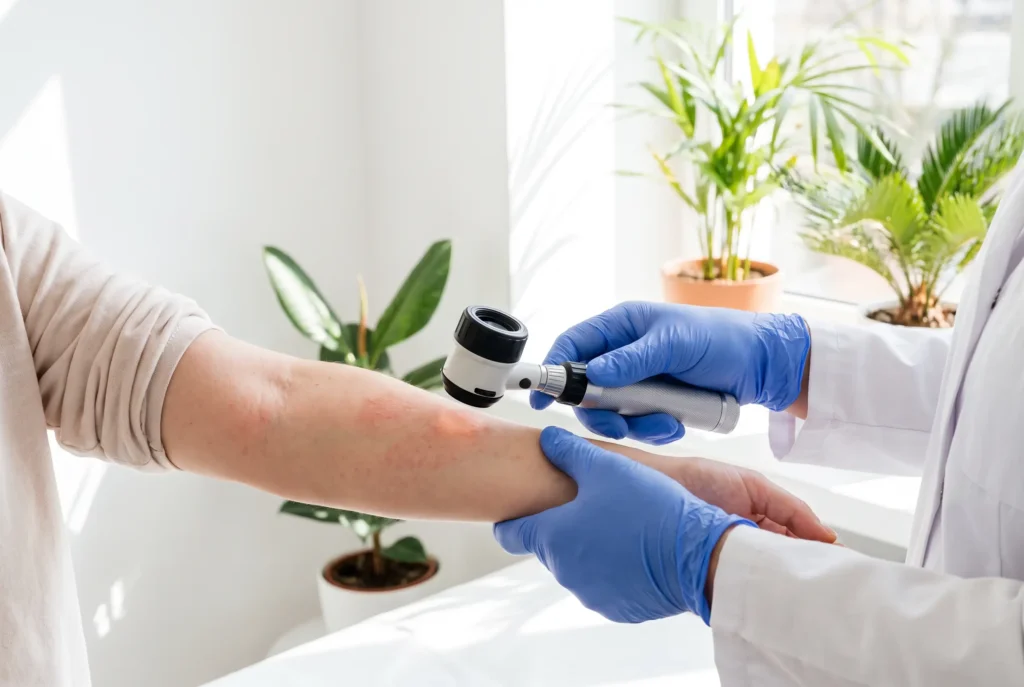
It began as a small cut, a graze or a bite that seemed to be healing normally. Now the skin around it is red, hot, swollen and tender, and the redness is visibly larger than it was this morning. That is cellulitis, a bacterial infection spreading through the deeper layers of skin, and it is one of the few things here that genuinely should not wait until tomorrow. Cellulitis treatment in Bang Tao needs antibiotics started the same day.
How to recognise it
The signs are consistent:
- Redness spreading outward, with a poorly defined edge rather than a sharp border
- Skin that is hot to touch
- Swelling and tightness
- Pain that increases rather than settles
- Sometimes a red streak running up the limb
- Fever, chills or feeling generally unwell
Drawing a pen line around the edge of the redness is genuinely useful. If the redness has passed that line a few hours later, it is spreading and needs treatment now rather than observation.
Why it develops so readily in Phuket
Any break in the skin can be the entry point, and a holiday here supplies plenty: coral cuts, insect bites that have been scratched, scooter grazes, blisters from new sandals, and cracked skin between the toes from athlete’s foot.
Heat and humidity keep skin damp, sea and pool water carry organisms, and wounds are constantly re-exposed rather than kept clean and dry. An injury that would be trivial at home becomes an infection here within a couple of days.
Treatment
Oral antibiotics for seven to ten days treat most cases, and the redness usually stops spreading within 48 hours even though it takes considerably longer to fade completely. Finish the entire course.
Rest and elevate the affected limb. For a leg, that means genuinely raised — foot above hip level, not simply resting on the floor. Elevation does far more than people expect and is the part most often ignored.
We also treat the underlying entry point with wound dressing, and treat athlete’s foot where that is how the bacteria got in, because otherwise it simply recurs.
When it needs hospital care
Go to a hospital, or come in immediately, if there is:
- Fever with shaking chills
- Redness spreading quickly, over hours rather than days
- Pain that seems out of proportion to how the skin actually looks
- Blistering, dark patches or skin breaking down
- Cellulitis on the face, especially around the eye
- Confusion, dizziness or a racing pulse
- No improvement after 48 hours of antibiotics
Pain markedly out of proportion to the appearance is the warning sign for a rare deep infection that is a surgical emergency. Facial cellulitis near the eye also needs hospital assessment rather than tablets.
Do not wait to see how it looks tomorrow
This is the practical message and it is worth being blunt about. Cellulitis treated on day one is a course of tablets and a mildly ruined week. Cellulitis left for three days can mean intravenous antibiotics, hospital admission, and a flight home missed.
We see the same pattern constantly: a traveller who noticed redness two days ago, tried an antiseptic cream, and now arrives with infection halfway up the leg. Antiseptic creams do not treat cellulitis, because the infection is in the deeper layers of skin where a topical cream simply cannot reach.
Recovery, and stopping it recurring
Expect the redness to fade over one to two weeks, often leaving the skin looking slightly discoloured and flaky for longer. Swelling in a leg can take several weeks to settle fully, and mild residual swelling is normal rather than a sign of continued infection.
Having had cellulitis once makes another episode more likely, because the infection damages local lymphatic drainage. The main preventive measures are treating athlete’s foot properly — it is the commonest entry point and is easy to ignore — keeping skin moisturised so it does not crack, cleaning and covering every break in the skin however trivial, and dealing with any leg swelling.
If you get recurrent episodes, that is worth investigating rather than simply treating each one. And while you are still here, take every subsequent cut, bite and graze seriously — see wound dressing for how a five-minute dressing prevents the whole cycle repeating.
Things that look like cellulitis but are not
Several conditions produce a red, swollen, warm leg, and treating all of them with antibiotics is both ineffective and common.
The most important alternative is a deep vein thrombosis, which causes a swollen, aching, warm calf — usually without the sharply increasing redness and fever of cellulitis, and often after a long flight or a period of immobility. That combination in a traveller who flew twelve hours three days ago needs assessing urgently rather than being treated as an infected bite, because the risk is a clot travelling to the lungs.
Venous eczema produces red, scaly, itchy skin around the ankles in both legs, and cellulitis is almost never bilateral — redness in both legs simultaneously is a strong argument against infection. An acute gout attack causes an exquisitely painful, red, hot joint, most often the big toe, which people regularly mistake for an infected wound. A contact reaction to a new sunscreen or a plant produces redness matching exactly where the substance touched.
The distinguishing questions are whether it is spreading, whether there is fever, whether there was a break in the skin, and whether it is one leg or both. If you are unsure, come in — an examination settles it in a few minutes, and the wrong assumption in either direction costs considerably more than the visit.
Frequently asked questions
How much does treatment cost?
A consultation with a course of oral antibiotics is inexpensive. Cases needing daily review, dressings or a hospital referral cost more, and are quoted first.
How quickly should it improve?
Spreading should stop within about 48 hours of starting antibiotics. The redness fades more slowly over a week or more. If it is still advancing after two days, come back.
Is it contagious?
No. Cellulitis is an infection in your own skin and cannot be passed to anyone else.
Can I swim?
No, not until it has resolved. Sea and pool water on infected or broken skin makes it worse and can introduce further organisms.
Can a doctor come to my hotel?
Yes. A doctor hotel visit can assess it, start antibiotics and review daily, which suits anyone struggling to walk on an infected leg.
Can I fly with cellulitis?
Once it is clearly improving on antibiotics, usually yes. Flying while it is still spreading is a poor idea — long periods sitting still worsen leg swelling and you are a long way from help.
Come in, or we come to you
Take Care Medical Clinic Bang Tao is open open 24 hours, 7 days a week on Bandon Road in Cherng Talay, a few minutes from Bang Tao Beach and Laguna Phuket. Walk in without an appointment, call +66 81 718 9080, or message us on WhatsApp. If you would rather not move, ask for a doctor hotel visit and we will come to your room.