Dengue fever treatment in Bang Tao
It begins like flu, then gets considerably worse. A fever that climbs fast, a headache sitting directly behind the eyes, and an ache deep in the bones and muscles that earned dengue its old name of breakbone fever. Phuket records dengue every year and cases rise through the rainy months. Dengue fever treatment in Bang Tao starts with a blood test, because knowing changes what you must not take.
Do not take ibuprofen or aspirin
This is the single most important sentence on this page. Dengue lowers platelets, the cells that allow blood to clot. Ibuprofen, aspirin, naproxen and diclofenac all interfere with platelet function independently, and taking them during dengue meaningfully raises the risk of serious bleeding.
Use paracetamol only, and stay within the daily limit printed on the box. If you have already taken ibuprofen before you knew, do not panic — stop it and tell the doctor. A great many people reach for it precisely because it works better on deep muscle pain than paracetamol does, which is exactly why this warning needs stating rather than assuming.
How to recognise dengue
The pattern is reasonably consistent:
- Sudden high fever, often 39 to 40C
- Severe headache, classically behind the eyes and worse on moving them
- Deep muscle and joint pain
- Nausea and vomiting
- A blotchy red rash appearing around day three to five
- Extreme tiredness that outlasts the fever by weeks
Symptoms begin four to ten days after the mosquito bite. The mosquito that carries dengue bites during daylight, particularly early morning and late afternoon, which is why people who were meticulous with repellent at dinner still catch it.
Testing, and why it happens early
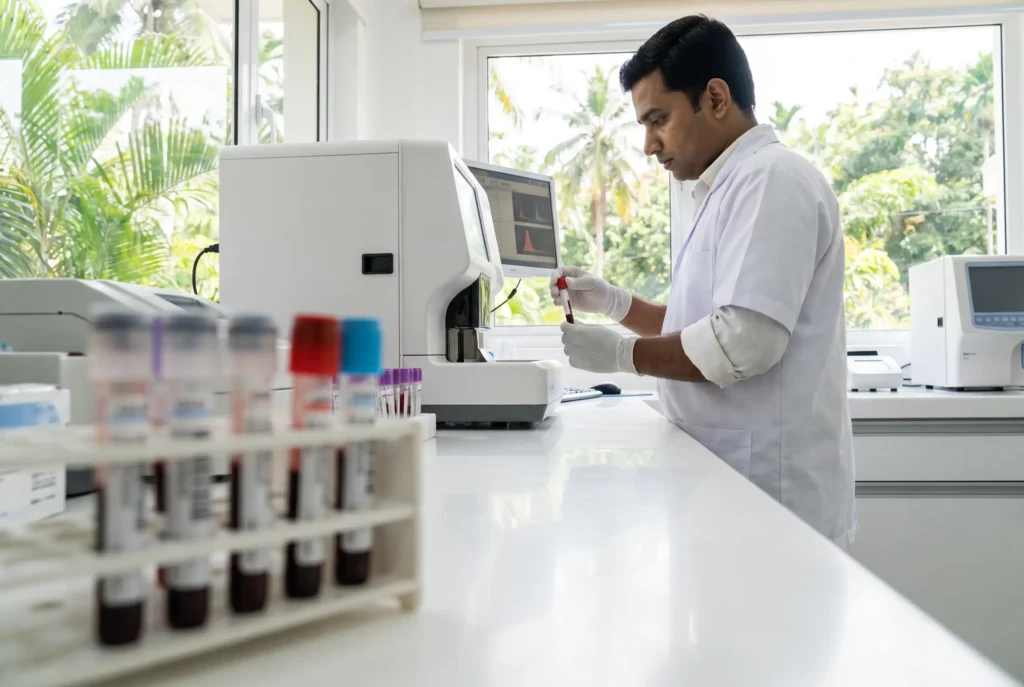
An NS1 antigen test detects dengue from the first day of fever, and antibody tests add information a few days in. Alongside it we run a full blood count to establish the platelet level and haematocrit, and those are the numbers followed from then on. See blood tests.
Testing matters because there is no reliable way to distinguish dengue from other tropical fevers by examination alone. It changes your pain relief, it determines how closely you need watching, and it tells you honestly when it is safe to fly.
The dangerous phase is when the fever drops
This is counter-intuitive and it is what catches people out. Days four to six, as the temperature falls and you begin to feel better, are exactly when severe dengue develops if it is going to. Plasma leaks from the blood vessels and the platelet count reaches its lowest point.
Go to a hospital immediately if you develop severe abdominal pain, persistent vomiting, bleeding from the gums or nose, blood in vomit or stool, black tarry stools, difficulty breathing, cold clammy skin, restlessness, or a sudden collapse in energy just as the fever settles.
Feeling better and then rapidly worse is the warning pattern. Anyone recovering from dengue at home should have someone checking on them daily through that window rather than being left to sleep it off.
How it is managed
There is no antiviral for dengue. Treatment is supportive, and supportive treatment works: fluids, paracetamol, rest, and monitoring of the blood count. Most people recover fully at home with daily review.
Fluid is the mainstay. If you cannot keep water down, an IV drip does the job properly. We repeat the blood count daily through the critical phase and admit to hospital if platelets fall far or warning signs appear.
Expect the fatigue to linger for two to four weeks after the fever has gone. That is entirely normal, it is not a relapse, and it is the part most people are unprepared for.
Avoiding it for the rest of your stay
Since there is no useful vaccine for a short trip, prevention is entirely about not being bitten.
Use repellent containing DEET or picaridin and apply it during the day, not just in the evening — this mosquito is a daytime biter and that single fact defeats most people’s routine. Reapply after swimming and after sweating heavily.
Empty standing water anywhere near where you are staying: plant saucers, buckets, pooled water on balconies and in unused bathrooms. Aedes mosquitoes breed in remarkably small amounts of clean water and rarely travel far, so the mosquito biting you was almost certainly born within a hundred metres. Air conditioning and a fan both help, since they are weak fliers.
Having had dengue once does not protect you. There are four types, and a second infection with a different type carries a higher risk of severe disease — so previous dengue is a reason to be more careful, not less.
Frequently asked questions
How much does a dengue test cost?
The rapid NS1 test is inexpensive and is usually run with a full blood count, which is also modestly priced. You are quoted for both before any blood is taken.
Can a doctor test me at my hotel?
Yes. A doctor hotel visit can take the sample in your room, which suits someone flattened by fever. Results follow from the clinic laboratory.
Can I fly home with dengue?
Not during the fever or the critical phase. Once the fever has settled, platelets are recovering and you are eating and drinking normally, flying is usually fine. Get assessed before rebooking rather than after.
Can I catch dengue twice?
Yes, there are four types. A second infection with a different type carries a higher risk of severe dengue, so a previous episode is a reason for more caution rather than less.
How long does dengue last?
The fever typically runs three to seven days. The exhaustion afterwards commonly lasts two to four weeks, and occasionally longer. That tail is normal and does not mean something has gone wrong.
Is dengue contagious?
Not directly between people. It spreads only through mosquito bites, so you cannot catch it from someone you are travelling with — though if they were bitten locally, you are in the same place as the mosquitoes.
Come in, or we come to you
Take Care Medical Clinic Bang Tao is open open 24 hours, 7 days a week on Bandon Road in Cherng Talay, a few minutes from Bang Tao Beach and Laguna Phuket. Walk in without an appointment, call +66 81 718 9080, or message us on WhatsApp. If you would rather not move, ask for a doctor hotel visit and we will come to your room.